

Psychosocial Risk Factors at Work: Why the Traditional Harm-Only View Is Incomplete
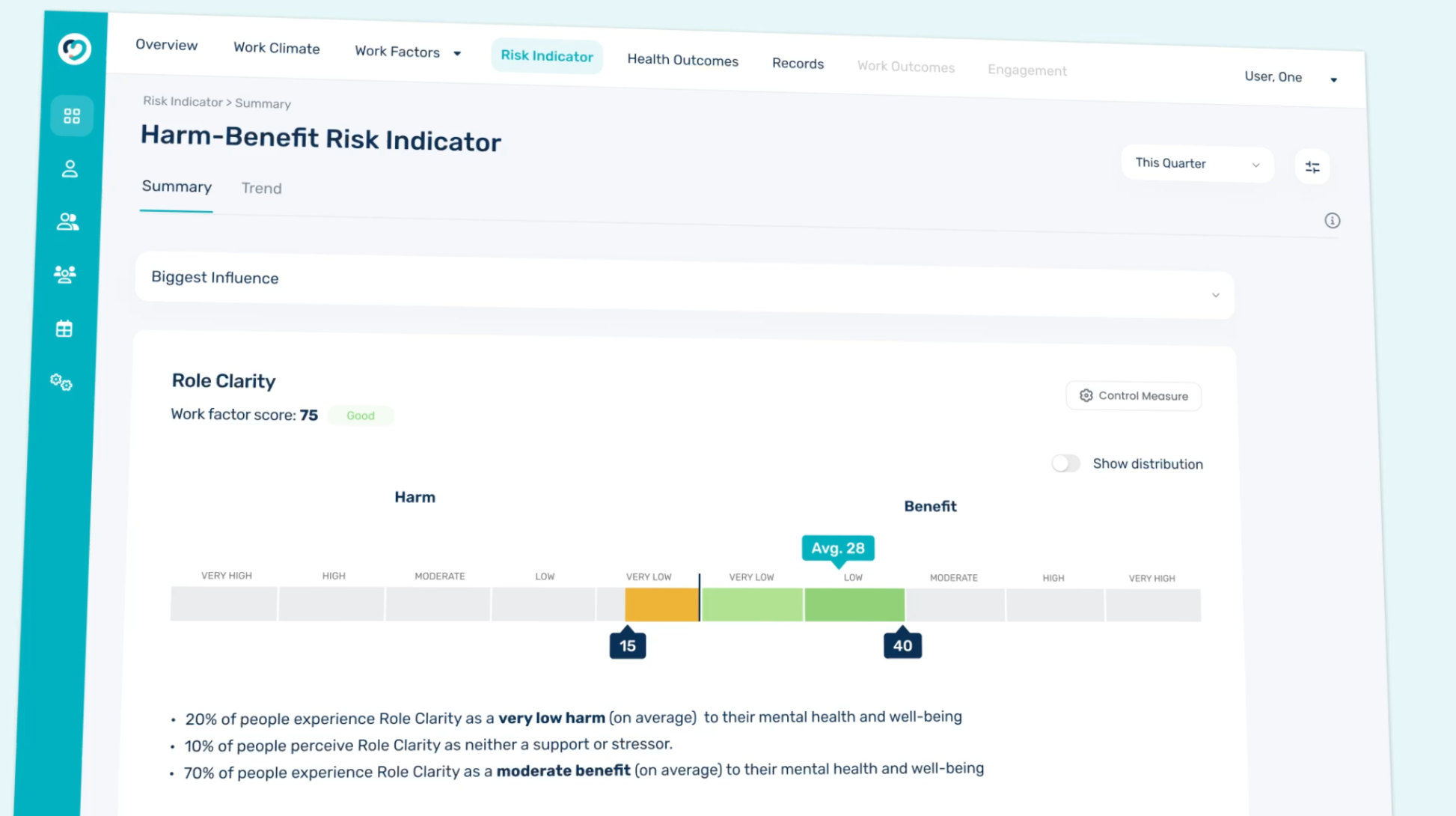
Psychosocial risk factors are workplace conditions that have the potential to affect workers’ psychological health. Under Australian WHS legislation, organisations are required to identify, assess, and manage these factors as part of their duty of care — applying the same systematic rigour used for physical hazards.
Most organisations understand this much. What is less well understood is that the conventional approach to assessing psychosocial risk factors captures only half the picture.
What Are Psychosocial Risk Factors?
Psychosocial risk factors arise from how work is designed, organised, managed, and experienced. They include both the conditions that may cause psychological harm and those that may actively protect or benefit psychological health.
Common psychosocial risk factors include:
- Job demands — workload intensity, time pressure, and emotional demands
- Job control — the degree of autonomy and decision-making authority workers hold
- Manager and organisational support — the quality of leadership and access to resources
- Role clarity — the degree to which expectations and responsibilities are clearly defined
- Workplace relationships — incivility, conflict, bullying, and harassment
- Reward and recognition — whether effort and contribution are acknowledged
- Organisational fairness — perceptions of equity in how decisions are made and communicated
- Change management — how restructures, process changes, and uncertainty are handled
These factors are recognised under Safe Work Australia’s Model Code of Practice: Managing Psychosocial Hazards at Work and must be managed as part of a structured WHS risk management process.
The Problem With a Harm-Only Assessment
Traditional approaches to psychosocial risk assessment are modelled on the occupational hygiene framework developed for physical hazards. In this model, the objective is to identify hazards and assess the likelihood and severity of future harm.
For physical risks — a chemical exposure, a fall risk, a machinery hazard — this approach is appropriate. Physical hazards cause harm, and the goal is to eliminate or control the source.
Psychosocial risk factors are fundamentally different in two important respects.
First, they can both harm and benefit. Unlike a chemical exposure, which is harmful in any concentration above a threshold, most psychosocial factors sit on a continuum. Poor manager support causes harm. Good manager support actively protects and benefits psychological health. Poor role clarity creates stress. Clear, well-defined roles contribute to wellbeing and performance. The absence of harm does not automatically mean a factor is protective — and benefit must be measured in its own right, not inferred from the lack of negative reporting.
Second, they are interrelated and cumulative. Physical risks are typically assessed individually. Psychosocial risk factors interact with each other, often in ways that substantially alter the overall risk picture. Consider how organisational unfairness might compound the effect of excessive workload, amplifying the risk of psychological injury beyond what either factor would generate in isolation. Or how strong manager support and clear role expectations can significantly buffer the harm that might otherwise result from high emotional demands.
An assessment approach that measures harm only — and that treats each factor in isolation — will systematically misrepresent the actual state of an organisation’s psychosocial environment.
When the Data Tells a Different Story
The practical implications of this become clear when real assessment data is examined.
An organisation may identify through a traditional hazard identification process that workloads and emotional demands are being reported as significant concerns. On a harm-only basis, these appear as high-priority risks requiring urgent intervention.
But when both harm and benefit are assessed, and the interrelated nature of psychosocial risk factors is taken into account, a different picture can emerge. Where employees also experience strong manager support and high role clarity, the severity of harm attributable to workload and emotional demands is substantially lower than the hazard identification data suggested. In some cases, when protective factors are sufficiently strong, employees may even experience high demands as a source of meaning and motivation rather than harm.
This is not an argument for ignoring job demands. It is an argument for understanding how psychosocial risk factors operate as a system — because only then can control measures be designed to have maximum effect.
An early client study conducted using the Mibo platform illustrates the other side of this dynamic. Within a single organisation with broadly acceptable overall psychosocial scores, analysis at team level revealed stark differences: one team reported no protective factors in the high-benefit zone and six factors causing moderate to high psychological harm. Another team within the same organisation reported several very high protective factors and all psychosocial demands in the very low risk zone. The aggregate results masked both localised risk and localised strength — neither of which would have been visible through a conventional whole-of-organisation assessment.
What a Complete Assessment of Psychosocial Risk Factors Looks Like
A rigorous approach to assessing psychosocial risk factors requires three capabilities that conventional tools do not provide.
Measuring both harm and benefit. Each psychosocial factor must be assessed for both its harmful and its protective influence. This gives organisations a true picture of how employees are actually experiencing their work environment — not just which hazards are present.
Assessing the interrelated nature of factors. Rather than treating each factor as independent, a complete assessment identifies which factors have the greatest systemic influence across the psychosocial environment. This allows control measures to be prioritised for maximum return — targeting the factors that, when improved, are most likely to drive improvement across multiple areas simultaneously.
Capturing variation within the organisation. Because psychosocial risk factors are shaped by social dynamics, team composition, and individual leadership, risk profiles vary significantly across divisions, teams, and roles. An aggregate organisational score can obscure both localised harm that requires urgent attention and localised strength that can be built on.
Drawing on over 500,000 data points assessed through the Mibo Psychosocial Risk Management Assessment (PRMA), independently evaluated by the Griffith University RISE Research Centre, the Mibo platform’s Risk-Protective Ratio (RPR) provides a single metric summarising the cumulative balance of an organisation’s psychosocial environment — integrating both risk and protective factors across the full workforce. Organisations with a more favourable RPR consistently demonstrate lower proportions of salary lost to work-related stress, absenteeism, presenteeism, and turnover.
Implications for WHS Compliance
From a WHS compliance perspective, a harm-and-benefit approach to psychosocial risk factors is not merely a methodological preference — it is a more defensible compliance position.
Regulators expect organisations to assess psychosocial risks systematically and to implement controls that can be demonstrated to be effective. When an organisation understands not only where harm is occurring but also which protective factors are operating — and how they interact — it is far better positioned to design targeted, evidence-based control measures and to demonstrate their effectiveness over time.
A harm-only assessment that flags high demands as a risk without accounting for the protective factors in place may generate unnecessary remediation activity. Conversely, it may also miss genuine risk that is masked at the aggregate level but concentrated within specific teams or roles.
Understanding Your Organisation’s Psychosocial Risk Factors
Managing psychosocial risk factors effectively starts with measuring them accurately — capturing the full picture of how work is experienced, where harm is concentrated, and which protective factors are doing the most work.
To learn more about how the Mibo platform supports a complete, WHS-aligned approach to psychosocial risk factor assessment, speak with our team.