

4 Keys to Managing the Risk of Psychosocial Hazards at Work…

Featured

Managing Mental Health at Work: What Organisations Are Actually Responsible For
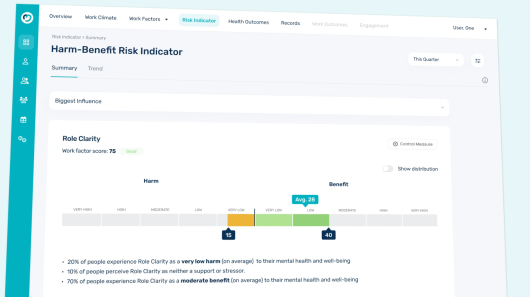
Psychosocial Risk Factors at Work: Why the Traditional Harm-Only View Is Incomplete
4 Keys to Managing the Risk of Psychosocial Hazards at Work
Managing the risk of psychosocial hazards at work is a legal requirement across Australia — not a discretionary wellbeing initiative. Under the Model Code of Practice: Managing Psychosocial Hazards at Work, organisations must identify, assess, control, and monitor psychosocial hazards with the same rigour applied to physical safety risks.
For many organisations, knowing where to begin — or how to improve an existing approach — is the real challenge. Leadership alignment, data gaps, and internal complexity can all slow progress. The following four keys provide a structured starting point for any organisation at any stage of its psychosocial risk management journey.
1. Clarify Your Organisation’s Psychosocial Risk Management Aims
Before selecting tools or launching assessments, it pays to be clear on what your organisation is actually trying to achieve. Your aims will be shaped by factors including company size, industry, workforce structure, and current psychosocial risk maturity.
Consider the following questions:
- Are we in the early stages and seeking to understand our psychosocial strengths, weaknesses, and risk priorities for the first time?
- Is our primary driver achieving WHS compliance with psychosocial hazards as efficiently as possible?
- Are we looking to go beyond compliance and build a measurably healthier psychosocial work environment?
- Do we want to integrate psychosocial risk management with related areas such as mental health support, respect at work, and employee wellbeing?
- Are we trying to understand how our existing wellbeing programmes are actually influencing psychosocial health outcomes?
These questions matter because they determine the scope, methodology, and resourcing of your approach. Organisations pursuing compliance have different needs to those building a long-term psychosocial safety climate. Getting clear on aims early prevents scope creep and misaligned investment later.
2. Secure Meaningful Leadership Buy-In
Psychosocial risk management does not succeed as a bottom-up initiative alone. In medium and large organisations especially, a common failure point is beginning the process without the commitment of leaders who have the authority — or the ability — to either drive or obstruct meaningful change.
Under WHS legislation, officers (including directors and senior executives) have a personal due diligence obligation to ensure psychosocial risks are being managed. This means leadership engagement is not just operationally important — it carries legal weight.
If you are not part of the executive team, engage leaders as early as possible. Share the regulatory context, the business case, and the proposed approach. Invite their input before plans are finalised. Leaders who have shaped a process are far more likely to champion it — and far less likely to become a barrier to implementation.
Practically, this means presenting the psychosocial hazard management process as a risk management and governance requirement, not a culture or HR project. Frame the conversation around WHS duty of care, reputational risk, and workforce productivity — the language that drives executive attention.
3. Audit Your Existing Internal Data Sources
Most organisations have more relevant psychosocial data than they realise. Before initiating a new assessment, conduct a structured Desktop Review to identify and consolidate what already exists.
Key internal data sources typically include:
- Absenteeism and sick leave patterns — frequency, duration, and any team-level clustering
- Staff turnover data — voluntary resignation rates, exit interview themes, and high-turnover roles or locations
- Workers’ compensation claims — psychological injury claims in particular
- Workload and hours data — overtime, on-call requirements, and unplanned leave coverage
- Existing policies and procedures — what psychosocial controls are already documented and in effect?
- Current wellbeing and support measures — EAP utilisation, mental health programmes, manager training completed
This data serves two purposes. First, it reveals patterns and gaps in the current approach — where harm signals are already present, and where controls may not be working. Second, it establishes a baseline that allows the effectiveness of future interventions to be measured over time.
Reviewing existing data before launching new assessments also demonstrates to workers and regulators that your organisation is engaging with the evidence, not just running compliance exercises.
4. Conduct a Valid, Reliable Quantitative Psychosocial Risk Assessment
A structured psychosocial risk assessment is the most defensible way to establish a clear picture of psychosocial hazard exposure across your organisation. It provides the quantitative baseline needed to prioritise control measures, inform worker consultation, and demonstrate WHS compliance to regulators.
Not all assessment tools are equal. For enterprise organisations, the assessment methodology should be:
- Validated — grounded in peer-reviewed research and tested for reliability across workplace populations
- Comprehensive — covering the full range of psychosocial hazards, not just the most visible ones
- Actionable — producing data that can be segmented by team, role, or location to drive targeted interventions
- Repeatable — enabling ongoing measurement and comparison over time
The Mibo platform uses a psychosocial risk assessment independently evaluated by the Griffith University RISE Research Centre, providing organisations with a validated, enterprise-grade foundation for managing psychosocial hazards under Australian WHS law. Assessment data is presented through the Mibo platform’s analytics dashboard, enabling safety leaders to identify risk priorities and track intervention effectiveness at scale.
Starting Your Psychosocial Risk Management Journey
Managing the risk of psychosocial hazards at work is not a single event — it is an ongoing, structured process. Organisations that approach it with clear aims, executive alignment, solid internal data, and a validated assessment methodology are far better positioned to meet their WHS obligations and improve outcomes for their workforce.
If you would like to discuss how the Mibo platform can support your organisation’s psychosocial risk management approach, schedule a call with our team.