

Managing Mental Health at Work: What Organisations Are Actually Responsible For

Featured

Psychosocial Wellbeing at Work: Why Measuring Outcomes Is the Missing Step
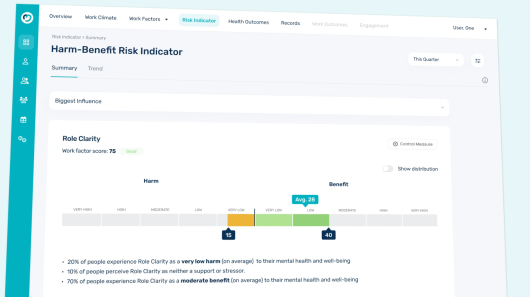
Psychosocial Risk Factors at Work: Why the Traditional Harm-Only View Is Incomplete
One of the most common objections that surfaces when organisations begin managing mental health at work is a version of this:
“We can’t be responsible for employees’ mental health — they have lives outside of work. Financial stress, relationships, family. We can’t control any of that.”
It’s a reasonable concern. And it’s one that, left unaddressed, can stall or derail psychosocial risk management initiatives before they gain traction. The problem is that the objection is based on a misreading of what the law actually requires.
Here’s how to respond — and why getting this framing right is critical for securing leadership buy-in.
What the WHS Code Actually Says About Mental Health at Work
The Model Code of Practice: Managing Psychosocial Hazards at Work (Safe Work Australia) is unambiguous on this point: organisations are not responsible for the mental health of employees.
Mental health is multifactorial. It is shaped by genetics, life history, personal circumstances, and a range of factors entirely outside any employer’s influence or control. The WHS framework has never suggested otherwise.
What the Code does require is that organisations take a positive duty to manage the psychosocial risks their work environment poses to employees’ psychological health. These are two fundamentally different obligations — and the distinction matters enormously when communicating with leaders and executives who may be instinctively resistant.
The legal requirement is to follow a structured four-step risk management process:
- Identify the psychosocial work factors (hazards) that may pose a risk to psychological health
- Assess the level of risk those factors present
- Implement control measures to minimise or mitigate those risks, so far as is reasonably practicable
- Monitor the effectiveness of those controls on an ongoing basis
Critically, the Code does not require that an organisation eliminate all psychosocial risks — only that it can demonstrate it has taken reasonable, proactive steps to identify and manage them.
Work Factors, Not Just Hazards
At Mibowork, we prefer the term work factors over the more clinical language of “hazards” — and this framing has practical value when engaging leadership.
The reason: most psychosocial work factors do not operate in one direction only. They have the potential to either harm or support employee psychological health, depending on how they are managed. High emotional demands in a customer-facing role are a genuine psychosocial risk. But when employees also experience strong organisational support and manager care, the risk profile changes substantially.
This is not just a communications preference — it reflects an important evidence-based reality. Psychosocial work factors interact. Measuring and monitoring both the harm and benefit dimensions of those factors allows organisations to demonstrate not just that risks exist, but how control measures are actively mitigating them.
That is a far more defensible and commercially useful position than a binary pass/fail compliance checklist.
How to Talk About Mental Health at Work With Sceptical Leaders
The objection — “we can’t be responsible for their mental health” — typically comes from leaders outside the WHS function. Operations, finance, or commercial leaders who have both the influence to enable a psychosocial risk programme and the ability to block one.
The framing that tends to land with this audience:
Start with agreement. Acknowledge that their concern is valid. No organisation can or should be held responsible for the full complexity of an employee’s mental health. The Code agrees.
Clarify the actual obligation. The duty is to manage work-related psychosocial risks — the factors within the organisation’s control. Not to fix lives.
Return to the business case. Research consistently shows the scale of work’s contribution to mental health outcomes. A 2021 study of 2,100 Australian and New Zealand workers found that 92% of serious mental health concerns in the workplace were attributed to work-related stress. Approximately 20% of employees attribute their absenteeism directly to work-related stress. Beyond Blue has reported that 50% of employees have resigned due to a poor work environment.
These are not marginal figures. They represent material risk to workforce stability, productivity, and cost.
Close with three outcomes a psychosocial risk programme actually delivers:
- It reduces the risk of employees suffering a psychological injury that is directly attributable to work — which carries the greatest legal and reputational exposure
- It reduces the likelihood of work-related stress becoming a significant contributor to more complex mental ill-health conditions
- It supports performance, engagement, and retention — outcomes that resonate with every business function
Why Proactive Is the Only Defensible Position
The WHS framework is intentionally realistic about the nature of work. It does not expect organisations to create risk-free workplaces. What regulators do expect — and will look for during audits and in enforcement proceedings — is evidence that an organisation has taken structured, documented, and ongoing action to identify and manage psychosocial risks.
Reactive approaches are not sufficient. Traditional models of workplace mental health support, such as Employee Assistance Programmes, report average utilisation rates of 5–10%, and engagement most commonly occurs only when problems have already reached crisis point. This reactive model has been estimated to cost Australian businesses over $6.5 billion annually.
Proactive psychosocial risk management addresses the problem at its source — the work environment itself — rather than attempting to treat consequences after harm has occurred.
Managing Mental Health at Work Through a Risk Management Lens
The most effective way to manage mental health at work is not to treat it as a separate wellbeing program but to embed it within the organisation’s existing WHS risk management framework. That means identifying psychosocial work factors systematically, assessing their risk, implementing targeted controls, and tracking effectiveness over time.
When organisations take this approach, they achieve compliance, reduce legal exposure, and generate meaningful improvements in the workforce outcomes that leadership already cares about — productivity, turnover, absenteeism, and culture.
If you would like to discuss your organisation’s psychosocial risk management aims and how the Mibo platform can support a structured, WHS-aligned approach, get in touch with our team.