
Psychosocial Hazards Victoria: Complete Compliance Guide

Victorian employers face new comprehensive obligations for managing psychosocial hazards under the Occupational Health and Safety (Psychological Health) Regulations 2025. Understanding psychosocial hazards Victoria requirements is essential for workplace compliance and worker mental health protection.
Understanding Psychosocial Hazards Victoria Requirements
Psychosocial hazards Victoria regulations require all Victorian workplaces to identify, assess, and control workplace factors that can cause psychological harm. The Occupational Health and Safety (Psychological Health) Regulations 2025 commenced 1 December 2025, creating standalone, specific obligations for managing psychosocial risks.
These obligations apply under the Occupational Health and Safety Act 2004 (Vic) and the new Psychological Health Regulations 2025.
WorkSafe Victoria provides regulatory oversight, comprehensive guidance materials including the Psychological Health Compliance Code, and compliance support for managing psychosocial hazards in Victorian workplaces.
Victoria’s New December 2025 Framework
Occupational Health and Safety (Psychological Health) Regulations 2025
The Psychological Health Regulations 2025 commenced 1 December 2025, completing the national shift where every Australian jurisdiction now explicitly regulates psychosocial hazards. Victoria is the only jurisdiction not using the Model WHS laws, creating unique Victorian requirements.
Key Features:
- Standalone regulations separate from the Occupational Health and Safety Regulations 2017
- Specific duties to identify, control, and review psychosocial hazards
- Modified hierarchy of controls tailored for psychosocial risks
- Enhanced consultation requirements with health and safety representatives
- Specific review triggers requiring control reassessment
Victoria’s Broader Definition
Victoria defines psychosocial hazards more broadly than Model WHS jurisdictions:
Victorian Definition: “Any factor or factors in work design, systems of work, the management of work, the carrying out of the work or personal or work-related interactions that may arise in the working environment and may cause an employee to experience one or more negative psychological responses that create a risk to the employee’s health or safety.”
This definition explicitly includes personal interactions arising in the work environment, not just work-related interactions, and references systems of work and the carrying out of work, providing a more expansive scope.
Psychological Health Compliance Code (September 2025)
WorkSafe Victoria published the Psychological Health Compliance Code (Edition 1, September 2025) providing authoritative guidance for Victorian employers.
Legal Status: A breach of the Compliance Code is not itself a breach of the OHS Act. However, an employer who complies with the Code will be taken to have complied with their duties under the Act and Regulations to the extent the Code addresses those duties. Courts will regard the Code as evidence of what employers reasonably ought to know about psychosocial hazards.
Prevention Plans Not Mandatory (But Recommended)
Unlike Queensland’s mandatory prevention plans, Victoria does not require written prevention plans. However, WorkSafe strongly recommends using their prevention plan template for:
- Documenting identified hazards
- Recording risk assessments
- Tracking control measures
- Demonstrating compliance
- Supporting continuous improvement
Common Psychosocial Hazards in Victorian Workplaces
The Compliance Code lists specific psychosocial hazards Victorian employers must identify:
Specifically Listed Hazards
- Aggression or violence
- Bullying
- Exposure to traumatic events or content
- Gendered violence (specifically called out in Victoria’s Code)
- High job demands
- Low job control
- Low job demands (under-stimulation)
- Low recognition and reward
- Low role clarity
- Poor environmental conditions
- Poor organisational change management
- Poor organisational justice
- Poor support
- Poor workplace relationships
- Remote or isolated work
- Sexual harassment (specific focus in Victoria’s Code)
Sexual Harassment and Gendered Violence
Victoria specifically highlights sexual harassment and gendered violence as key psychosocial hazards. The Equal Opportunity Act 2010 (EO Act) defines sexual harassment, and Victoria employers have positive duties under both OHS and equal opportunity laws.
EO Act Definition: A person sexually harasses another if they:
- Make an unwelcome sexual advance or unwelcome request for sexual favours, or
- Engage in any other unwelcome conduct of a sexual nature
in circumstances where a reasonable person would anticipate the other person would be offended, humiliated, or intimidated.
Your Legal Obligations as a Victorian Employer
Employers operating in Victoria must fulfil specific duties regarding psychosocial hazards under the new Regulations.
Primary Duty of Care
Section 21 of the OHS Act 2004 requires Victorian employers to provide and maintain a working environment for employees that is safe and without risks to health, so far as reasonably practicable. This expressly includes psychological health.
Specific Duties Under Psychological Health Regulations 2025
Victorian employers now have explicit duties to:
- Identify psychosocial hazards so far as reasonably practicable
- Control risks associated with psychosocial hazards by:
- First, eliminating risks so far as reasonably practicable
- If not reasonably practicable to eliminate, reducing risks using Victoria’s modified hierarchy
- Review and revise control measures in specified circumstances
Victoria’s Modified Hierarchy of Controls
Victoria implements a modified hierarchy specifically tailored for psychosocial risks, different from the traditional hierarchy:
Step 1: Eliminate the Risk
Eliminate the psychosocial hazard or risk so far as reasonably practicable (e.g., removing unnecessary job demands, redesigning work to eliminate harassment opportunities).
Step 2: Reduce the Risk
If elimination isn’t reasonably practicable, reduce the risk by altering:
- The management of work
- Plant used in work
- Systems of work
- Work design
- The workplace environment
This step focuses on higher-order, systemic controls like workload management systems, adequate staffing, role redesign, organisational structure changes, physical workspace improvements, and management practice changes.
Step 3: Information, Instruction, or Training
Only use information, instruction, or training to reduce the risk if:
- Altering management, plant, systems, work design, or environment is not reasonably practicable, OR
- These measures are used in combination with alterations from Step 2
Critical Restriction: Information, instruction, or training cannot be the exclusive or predominant risk control unless other measures are not reasonably practicable.
This modified hierarchy uses “different terminology applicable to controlling psychosocial risks” making it easier to apply than the traditional hierarchy, according to WorkSafe Victoria.
Mandatory Review Triggers
Victorian employers must review and, if necessary, revise control measures in these specific circumstances:
- Before alterations: Before altering any process or system of work likely to result in changes to psychosocial risks
- New information: If new or additional information about a psychosocial hazard becomes available
- Reported incidents: If any employee (or person on their behalf) reports a psychological injury or psychosocial hazard
- Notifiable incidents: After any notifiable incident under section 38 of the OHS Act involving psychosocial hazards
- Inadequate controls: If, for any other reason, risk control measures don’t adequately control the risks
- HSR requests: After receiving a request from a health and safety representative
Enhanced Consultation Requirements
The Regulations strengthen consultation requirements, specifically detailing how employers must involve health and safety representatives:
- Provide information to HSR first: Give the HSR all information about the matter that the employer provides or intends to provide to employees
- Early timing: Provide information to the HSR a reasonable time before giving it to employees (unless not reasonably practicable)
- Meet on request: Invite the HSR to meet, and actually meet if requested
- Genuine opportunity: Give the HSR a reasonable opportunity to express views and take those views into account
Officer Due Diligence
Officers and senior leaders have due diligence obligations requiring them to:
- Understand psychosocial hazard risks and Victoria’s modified hierarchy
- Ensure appropriate resources for implementing higher-order controls
- Implement and maintain appropriate systems
- Verify that resources and systems are effective
WorkSafe Victoria Resources and Support
WorkSafe Victoria provides extensive resources supporting psychosocial hazards Victoria compliance.
Compliance Code and Guidance
WorkSafe Victoria offers the Psychological Health Compliance Code (Edition 1, September 2025), comprehensive guidance materials on each psychosocial hazard, industry-specific fact sheets (e.g., sexual harassment), prevention plan template (recommended, not mandatory), online resources and training modules, and psychosocial hazard-specific fact sheets.
Advisory and Education Services
Since making the Regulations in September 2025, WorkSafe has undertaken extensive awareness and education activities including workplace advisory visits, educational seminars and webinars, industry engagement programmes, and sector-specific guidance.
WorkSafe responded to over 7,100 psychosocial hazard enquiries in 2024-25, demonstrating significant employer demand for guidance.
Compliance Approach
While the Regulations commenced 1 December 2025, WorkSafe inspectors will consider factors such as:
- Business size and resources
- Risk profile and complexity
- Previous experience with psychosocial risk management
- Maturity of psychosocial risk management practices
- Effort demonstrated since Regulations were made
However, WorkSafe expects all employers to demonstrate understanding of obligations and evidence of steps taken to ensure compliance. Given extensive guidance available since 2022 (Model Code) and September 2025 (Victoria’s Compliance Code), regulators expect rapid implementation.
Priority Sectors
WorkSafe Victoria’s Mental Health Strategy identifies priority sectors for enhanced focus:
- Health and social assistance
- Public administration and safety
- Education and training
Employers in these sectors can expect greater regulatory scrutiny, though obligations apply to all Victorian employers.
Incident Notification and Investigation
Serious psychological injuries must be notified to WorkSafe Victoria under section 38 of the OHS Act. The regulator investigates notifiable incidents and may take enforcement action where psychosocial hazards were inadequately managed.
Industry-Specific Considerations for Victoria
Different Victorian industries face distinct psychosocial hazard profiles.
Healthcare and Community Services (Priority Sector)
Victorian health services face high emotional demands and exposure to trauma, violence and aggression from patients and clients, sexual harassment from patients, visitors, or colleagues, shift work and extended hours causing fatigue, pandemic-related pressures and workforce shortages, and exposure to death and suffering.
Health sector employers need comprehensive approaches including adequate staffing (higher-order control), violence prevention environmental controls, clear boundaries and support for harassment, and trauma-informed supervision.
Education Sector (Priority Sector)
Victorian schools, TAFEs, and universities confront student behavioural challenges including aggression, workload and administrative demands requiring systemic management, sexual harassment from students, parents, or colleagues, community expectations and scrutiny, sector-specific change pressures, and workplace relationship issues including bullying.
Education employers need work design addressing workload, clear policies and environmental controls for harassment, and support systems beyond just EAPs.
Public Administration and Safety (Priority Sector)
Victorian public sector organisations face organisational change and restructuring requiring careful management, public and political scrutiny creating pressure, complex stakeholder management, sexual harassment and bullying risks in hierarchical structures, and resource constraints affecting workload.
Public sector organisations require higher-order controls like change management processes, workload monitoring, and cultural initiatives.
Manufacturing and Logistics
Victoria’s manufacturing sector faces production pressures and tight deadlines, shift work and fatigue, job insecurity and precarious work, workplace conflict and poor relationships, and potential sexual harassment in male-dominated environments.
Manufacturing employers require practical controls including production planning, adequate staffing, fatigue management, and anti-harassment measures.
Professional Services and Finance
Melbourne’s professional services sector encounters high-pressure work environments and long hours, competitive dynamics creating stress, sexual harassment risks in hierarchical, social settings, organisational change impacts including restructures, and job insecurity.
Professional services firms need work design addressing hours and workload, cultural change for psychological safety, and robust anti-harassment frameworks.
Agriculture and Regional Industries
Regional Victorian businesses face isolation and remote work challenges, financial pressures and uncertainty, seasonal work stressors, limited access to support services, and risks from working alone or with itinerant workers.
Agricultural businesses need practical controls for isolated work, communication systems, and managing worker welfare.
Construction Industry
Victorian construction sites experience deadline and financial pressures, job insecurity and labour hire arrangements, workplace conflict and bullying, sexual harassment in male-dominated sites, and weather-related impacts.
Construction businesses require workload and deadline management, site culture initiatives, environmental controls for harassment, and conflict resolution systems.
Retail, Hospitality, and Tourism
Customer-facing Victorian businesses encounter customer aggression and challenging behaviour, sexual harassment from customers or colleagues, irregular and insecure work arrangements, understaffing pressures, and performance expectations.
These sectors need environmental controls (lighting, visibility, buddy systems), clear customer behaviour policies, adequate staffing, and anti-harassment measures.
Implementing Controls in Victorian Workplaces
Effective management of psychosocial hazards Victoria employers face requires systematic control implementation following the modified hierarchy.
Elimination Strategies
Where reasonably practicable, eliminate psychosocial hazards by:
- Removing unnecessary demands and stressors from roles
- Redesigning work processes and workflows
- Changing organisational structures to improve support and accountability
- Eliminating traumatic content exposure where possible
- Removing opportunities for sexual harassment (e.g., eliminating isolated work with customers)
Reducing Risk Through Alterations (Step 2 of Modified Hierarchy)
If elimination isn’t reasonably practicable, reduce risks by altering:
Management of Work:
- Implementing workload management and monitoring systems
- Improving management practices and leadership approaches
- Fair and transparent decision-making processes
- Recognition and reward systems
- Change management processes
Systems of Work:
- Rostering ensuring adequate rest and preventing isolation
- Communication systems enabling worker voice
- Incident reporting and response procedures
- Performance management designed to minimise stress
- Consultation and participation mechanisms
Work Design:
- Clear role definitions and accountabilities
- Appropriate autonomy and decision-making authority
- Job rotation limiting exposure to high-demand or traumatic work
- Team-based work reducing isolation
- Workload distribution and demand management
Workplace Environment:
- Physical workspace design (lighting, visibility, privacy)
- Environmental conditions (noise, temperature, comfort)
- Safe access and egress
- Spaces for breaks and recovery
- Design preventing harassment (eliminating blind spots, installing cameras)
Plant:
- Technology supporting work rather than creating stress
- Systems enabling rather than monitoring/pressuring workers
- Communication equipment for isolated workers
Information, Instruction, or Training (Step 3 – Not Predominant)
Only after implementing Step 2 alterations, use information, instruction, or training:
- Awareness training on recognising psychosocial hazards
- Manager training on supportive leadership
- Bystander intervention training
- Mental health awareness and stigma reduction
- Information about support services and EAP
Critical: These cannot be exclusive or predominant controls. They must support, not replace, systemic alterations.
WorkSafe Victoria Enforcement and Penalties
WorkSafe Victoria actively enforces psychosocial hazards Victoria compliance requirements under the new Regulations.
Enforcement Approach
WorkSafe uses education and advisory activities (significant effort since September 2025), improvement notices for identified breaches, prohibition notices for immediate risks, enforceable undertakings for serious matters, and prosecution for serious breaches or persistent non-compliance.
Transition Period Consideration: While inspectors will consider maturity and effort, WorkSafe expects rapid compliance given extensive guidance available. Employers cannot claim ignorance of requirements.
Penalty Provisions
Breaches of occupational health and safety duties can result in substantial penalties under Victorian legislation:
Category 1 (Reckless Conduct causing death or serious injury): Up to $1,644,610 for corporations, $329,940 and/or 5 years imprisonment for individuals.
Category 2 (Failure to comply with duty – reckless): Up to $822,300 for corporations, $164,970 for individuals.
Category 3 (Failure to comply with duty): Up to $411,150 for corporations, $82,485 for individuals.
Recent Context
WorkSafe Victoria has already demonstrated willingness to address psychosocial hazards, responding to over 7,100 enquiries in 2024-25. With specific Regulations now in force, expect increased enforcement activity.
WorkCover Victoria and Psychological Injury Claims
WorkSafe Victoria (operating as WorkCover for workers compensation) manages psychological injury claims related to psychosocial hazards.
Claim Statistics and Trends
Victorian psychological injury claims increasingly relate to work-related stress and burnout, workplace bullying and sexual harassment, exposure to traumatic incidents, and organisational change impacts.
Concerning Statistics: Only 42% of workers with mental injury returned to work within six months in the last financial year, compared with 75% for physical injuries. This demonstrates the severity and duration of psychological injuries.
Prevention Benefits
Proactive management of psychosocial hazards Victoria workplaces face following the modified hierarchy delivers:
- Reduced workers compensation premiums
- Decreased claim frequency and costs
- Improved return-to-work outcomes for psychological injuries
- Lower absenteeism and presenteeism
- Improved productivity and performance
- Enhanced employer brand and reputation
- Reduced legal and regulatory risk
Return to Work Obligations
Victorian employers have obligations to support injured workers’ return to work, including those with psychological injuries. Effective psychosocial risk management creates workplaces where psychologically injured workers can safely return.
Best Practice Examples in Victoria
Leading Victorian organisations demonstrate effective psychosocial hazard management aligned with the new Regulations.
Systematic and Regular Assessment
Best practice involves comprehensive risk assessments using validated psychosocial assessment tools, worker surveys and focus groups with genuine consultation, analysis of incident, complaint, and claim data, consideration of organisational change impacts, and involvement of HSRs early in assessment processes.
Integrated Management Approaches
Successful Victorian organisations integrate psychosocial risk management with existing OHS management systems applying modified hierarchy, human resources strategies and policies from recruitment onwards, organisational development and change management processes, business planning and strategy including resource allocation, and performance management designed to minimise psychosocial stress.
Strong Leadership and Governance
High-performing organisations demonstrate visible senior leadership commitment and role modelling of psychological safety, clear governance structures and accountabilities for psychosocial risk, management capability development programmes on prevention, inclusion of psychosocial metrics in performance frameworks and reporting, and investment in higher-order controls not just training/EAPs.
Following the Modified Hierarchy
Best practice Victorian organisations prioritise elimination where possible (e.g., removing unnecessary stressors), invest in alterations to management, systems, work design, and environment, use training/information to support, not replace, systemic controls, document rationale for controls chosen and hierarchy application, and regularly review effectiveness using worker feedback and data.
Common Implementation Challenges in Victoria
Victorian employers commonly face these obstacles under the new Regulations.
Understanding the Modified Hierarchy
Victoria’s modified hierarchy differs from traditional hierarchy and Model WHS approaches. Employers must understand:
- The focus on “altering” management, systems, design, and environment
- That training/information cannot be predominant controls
- How to apply the hierarchy to psychosocial risks specifically
Resource Allocation
Implementing higher-order alterations requires investment. Smaller Victorian businesses may lack dedicated resources but must still comply. WorkSafe emphasises that reasonable practicability considers resources alongside risk severity.
Cultural and Mindset Barriers
Some workplaces face resistance to addressing psychosocial issues, stigma around mental health, or belief that “stress is just part of the job.” Building awareness, demonstrating leadership commitment, normalising psychological safety conversations, and showing business benefits helps overcome barriers.
Assessment and Measurement Complexity
Psychosocial risks can be harder to identify and measure than physical hazards. Using multiple assessment methods including worker consultation, incident/complaint data, organisational factors, and validated tools provides robust understanding. Both objective and subjective measures are necessary.
Sustaining Momentum
Initial enthusiasm can wane over time. Embedding psychosocial risk management in business-as-usual processes, demonstrating ongoing value, maintaining HSR engagement, and linking to business performance maintains momentum.
Meeting Review Trigger Requirements
The Regulations specify six review triggers. Employers must implement systems ensuring reviews occur when triggered, documenting review processes and outcomes, and revising controls when necessary based on review findings.
Action Plan for Victorian Employers
Victorian businesses should follow these steps for psychosocial hazards Victoria compliance under the new Regulations.
Immediate Actions (December 2025 onwards)
Obtain and review WorkSafe Victoria’s Psychological Health Compliance Code, understand Victoria’s modified hierarchy and its application, review current psychosocial risk management practices against new requirements, identify reliance on training/EAPs as primary controls (insufficient), engage workers and HSRs in preliminary discussions about hazards, and assess priority areas requiring higher-order alterations.
Short-Term Implementation (Q1 2026)
Conduct systematic psychosocial risk assessments using WorkSafe templates, identify psychosocial hazards across all categories in Compliance Code, assess risks considering severity, frequency, and duration of exposure, prioritise hazards for control implementation, develop implementation plan for higher-order alterations, establish enhanced consultation mechanisms with HSRs, and allocate resources for systemic controls.
Medium-Term Implementation (Q2-Q4 2026)
Implement priority alterations to management, systems, work design, environment, provide training to workers, managers, and leaders as supporting measure, establish monitoring and reporting systems tracking control effectiveness, implement review processes for six specified triggers, document processes, decisions, hazards, risks, controls, and reviews, consider using WorkSafe prevention plan template for documentation, and measure effectiveness through worker feedback and data.
Ongoing Compliance
Conduct reviews when any of six triggers occur (changes, new information, reports, incidents, inadequacy, HSR requests), regularly monitor control effectiveness through multiple measures, conduct periodic risk reassessments (at least annually), maintain active worker consultation and HSR engagement, review incident, complaint, and claim data for emerging risks, continuously improve approaches based on learnings and evidence, and stay informed of WorkSafe guidance and enforcement priorities.
Getting Support in Victoria
Victorian employers can access various support sources including WorkSafe Victoria advisory services (1800 136 089) and comprehensive guidance materials, occupational health and safety consultants with psychosocial expertise and Victorian requirements knowledge, organisational psychologists and wellbeing professionals, industry associations and employer groups with sector guidance, legal professionals specialising in Victorian OHS law, and workers compensation agents for injury management support.
Mibo for Victorian Workplaces
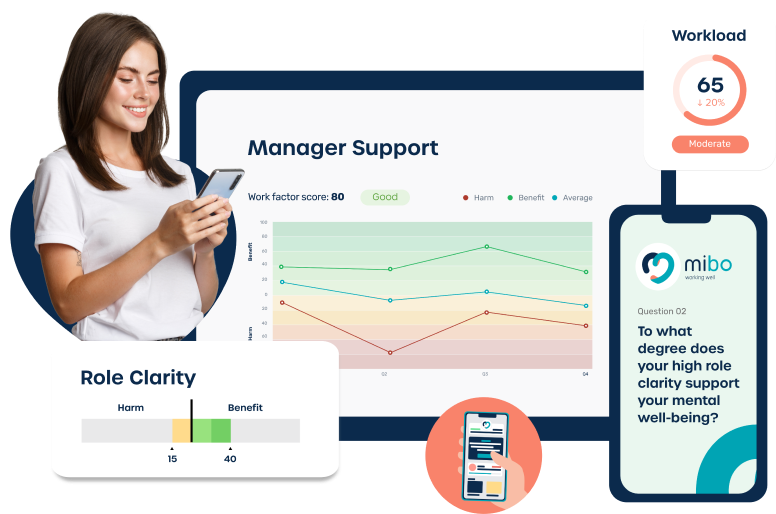
Mibo offers a dedicated platform for managing psychosocial hazards Victoria employers encounter under the Occupational Health and Safety (Psychological Health) Regulations 2025. The digital solution assists Victorian businesses in meeting their obligations under the Occupational Health and Safety Act 2004 and WorkSafe Victoria’s Psychological Health Compliance Code.
Victorian employers using Mibo access a next-gen psychosocial risk assessment tool aligned with WorkSafe Victoria Compliance Code requirements, hazard identification covering all Code-listed hazards including sexual harassment and gendered violence, Victoria’s modified hierarchy of controls framework guiding control selection and documentation, comprehensive hazard identification and reporting systems, control measure libraries specific to Victorian workplaces organised by hierarchy, worker consultation features meeting Victorian enhanced consultation duties including HSR early engagement, review trigger tracking for six specified circumstances requiring control review, compliance documentation for WorkSafe Victoria inspections demonstrating hierarchy application, prevention plan templates aligning with WorkSafe’s recommended approach, and continuous monitoring and review capabilities tracking control effectiveness.
The platform proves especially valuable for Victorian organisations managing Melbourne metro and regional operations, coordinating across multiple sites with consistent approaches, implementing Victoria’s modified hierarchy systematically, demonstrating compliance with new December 2025 Regulations, tracking alterations to management, systems, design, and environment, meeting enhanced HSR consultation requirements, responding to review triggers systematically, or operating in WorkSafe priority sectors (health, education, public administration). Mibo streamlines the complex requirements of managing psychosocial hazards Victoria workplaces face while maintaining robust compliance with the nation’s only standalone psychological health regulations.
Conclusion
Managing psychosocial hazards Victoria workplaces face is now governed by specific, standalone obligations under the Occupational Health and Safety (Psychological Health) Regulations 2025, which commenced 1 December 2025. This represents a significant milestone in Victorian workplace safety, placing psychological health on equal footing with physical safety through dedicated regulations.
Victoria’s approach differs from other jurisdictions through its modified hierarchy of controls specifically tailored for psychosocial risks, broader definition of psychosocial hazards including personal interactions, enhanced consultation requirements with HSRs, and specific review triggers requiring control reassessment. The Psychological Health Compliance Code provides practical, authoritative guidance for Victorian employers navigating these unique requirements.
WorkSafe Victoria’s priority sectors (health, education, public administration and safety) can expect enhanced regulatory focus, though obligations apply to all Victorian employers regardless of size or industry. The regulator’s response to over 7,100 psychosocial enquiries in 2024-25 demonstrates both employer concern and regulatory readiness to support and enforce compliance.
By implementing effective risk management processes following Victoria’s modified hierarchy, prioritising elimination then alterations over training and information, consulting meaningfully with workers and HSRs meeting enhanced requirements, investing in higher-order systemic controls, implementing robust review processes for specified triggers, and integrating psychosocial risk management into core business operations, Victorian employers protect workers, demonstrate legal compliance, and build healthier, more productive workplaces.
The stark statistic that only 42% of workers with mental injuries return to work within six months (compared to 75% for physical injuries) underscores why Victoria has introduced these comprehensive regulations. Effective management of psychosocial hazards Victoria businesses encounter under the 2025 requirements delivers benefits including improved worker mental health and wellbeing, enhanced organisational performance and productivity, reduced workers compensation costs and improved return-to-work outcomes, decreased absenteeism and turnover, strengthened workplace culture and employee engagement, reduced legal and regulatory risk, and competitive advantage through genuine psychological safety.
Victorian employers who prioritise psychological safety alongside physical safety, embrace the modified hierarchy’s focus on systemic alterations, and view the new Regulations as opportunity rather than burden will create workplaces where people can thrive, perform at their best, and contribute to organisational success without psychological harm.